
Paysafecard casino sites in Australia: what to check
 Available in AU
Contents
Australian casino payment claims need to be weighed against legal limits on online casino services and evidence that a method can actually be used.
The legal limits on online casino access in Australia
The legal starting point for Australian residents is the Interactive Gambling Act 2001. It makes it unlawful for operators to provide real-money online casino games to people physically in Australia. The restriction covers casino-style play such as poker, blackjack, roulette and pokies; it is not limited to one payment method or one way of accessing a service.
That distinction matters when you encounter claims about an Australian online casino that accepts Paysafecard. A payment option cannot change the legal status of the underlying service. Whether a site mentions Paysafecard, a card or another method, the relevant question is whether it is offering real-money online casino gambling to people in Australia. The law places the prohibition on operators providing that service.
The Act is enforced by the Australian Communications and Media Authority, commonly known as ACMA. Its role is to act on the rules applying to online gambling services, including the prohibition on casino-style services for people in Australia. The regulator’s involvement is not a sign that a particular offshore site is approved or protected for Australian customers. The framework is restrictive: online casino services are not a locally licensed consumer option.
If you want to pay by paysafecard, check the cashier before signing up: the details available here do not confirm which sites accept it. Use the licensing and deposit information below as a starting point for your checks.
1. Vegaz Casino
License: Curacao OGL/2024/1335/0780 · Min. deposit: EUR 20
Vegaz Casino lists a Curaçao licence, OGL/2024/1335/0780, and a minimum deposit of EUR 20. The available details do not confirm paysafecard availability.
2. LuckyVibe
License: Curacao Gaming Control Board OGL/2023/176/0095 (Hollycorn N.V.)
LuckyVibe lists a Curaçao Gaming Control Board licence, OGL/2023/176/0095, under Hollycorn N.V. The available details do not specify a minimum deposit or payment methods.
3. Roby Casino
License: Curacao eGaming (Roby Games Ltd)
Roby Casino is listed with a Curaçao eGaming licence under Roby Games Ltd. No deposit or payment-method details are provided here.
4. JustCasino
License: Curacao Gaming Control Board
JustCasino is listed with a Curaçao Gaming Control Board licence. The available details do not specify its deposit terms or whether paysafecard is accepted.
5. House of Pokies
License: international iGaming licence – jurisdiction not named in the source · Payout speed: PayID 1-24 hours · Min. deposit: A$30 (PayID from A$10)
House of Pokies lists an international iGaming licence, though the jurisdiction is not named in the source. Its minimum deposit is A$30, or A$10 via PayID, with PayID payouts stated as taking 1–24 hours.
6. Uptown Pokies
License: Curacao (operating since 2017) · Min. deposit: A$20
Uptown Pokies is listed as operating under a Curaçao licence since 2017, with a minimum deposit of A$20. The available details do not confirm paysafecard availability.
7. LevelUp Casino
License: Curacao eGaming OGL/2023/174/0082 (Dama N.V.) · Min. deposit: A$15
LevelUp Casino lists a Curaçao eGaming licence, OGL/2023/174/0082, under Dama N.V. Its stated minimum deposit is A$15.
8. SpinsUp
License: Curacao Gaming Control Board OGL/2023/174/0082 (Dama N.V.)
SpinsUp lists a Curaçao Gaming Control Board licence, OGL/2023/174/0082, under Dama N.V. No deposit or payment-method details are provided here.
9. WinSpirit Casino
License: Curacao eGaming OGL/2024/923/0383 (Antillephone N.V.) · Min. deposit: A$30
WinSpirit Casino lists a Curaçao eGaming licence, OGL/2024/923/0383, under Antillephone N.V. Its stated minimum deposit is A$30.
10. Playfina Casino
License: Curacao eGaming (Hollycorn N.V., since 2017) · Min. deposit: A$20-30 (depends on the offer)
Playfina Casino lists a Curaçao eGaming licence under Hollycorn N.V. and has operated since 2017; its minimum deposit is A$20–30, depending on the offer.
The law’s treatment of operators should be kept separate from its treatment of players. The Act does not explicitly make it a crime for an individual to use an offshore casino. That does not mean the service is lawful for the operator to provide, that it is endorsed by Australian authorities, or that a player has the protections they might expect when dealing with a local business. The absence of a specific player offence is not a stamp of approval.
This distinction can be easy to miss in promotional language. A site may describe itself as available to Australians or present payment details in Australian dollars, but those claims do not establish that it is permitted to offer casino gambling here. Nor does a familiar payment brand establish that an operator is subject to Australian casino regulation. Legal status comes from the law and the nature of the service, not from the wording on a payment page.
There is also a practical consumer-protection gap. Australian consumer law does not protect people using offshore casinos in the way it protects consumers dealing with businesses covered by Australian rules. If a dispute arises over an account, a balance or a payment, you should not assume that local consumer protections will resolve it. The fact that an offshore service can be reached online does not make it an Australian provider or bring it within the same protections.
Payments & Crypto for Australian Online Casinos
The distinction between accessibility and legality is important here. Offshore casino sites may be actively blocked and the rules are enforced; an address loading, a mobile page appearing, or a payment option being displayed is not evidence that an operator is entitled to serve Australian residents. A payment method such as Paysafecard does not create an exception to the Interactive Gambling Act, and searching for Australian pokies through a mobile device does not alter the legal position.
It is also worth separating “not explicitly criminalised for players” from “risk-free.” The first describes the Act’s treatment of individuals; it does not guarantee that a player will recover money, receive help from an Australian regulator in a private dispute, or access the same remedies available in a domestic consumer transaction. Those are different questions. The law’s main prohibition concerns the operator’s provision of the service, while consumer protections may be absent when a person chooses to deal with an offshore business.
For that reason, terms such as “Australian casino,” “Australian players welcome” or “Paysafecard accepted” should not be read as statements about local authorisation. They may describe a site’s marketing or a claimed transaction facility, but neither establishes legal permission. In Australia, the governing rule is that operators must not provide real-money online casino games to people physically located in the country. ACMA is the regulator responsible for enforcing that law, and Australian consumer law does not protect people using offshore casinos.
What to check before making a casino deposit
Before considering any payment, separate two questions: whether a service is legally available to you in Australia, and what checks its operator says it requires. A payment option shown on a page does not answer either question by itself.
KYC
Know Your Customer assessments are identity checks intended to establish who a customer is before they carry out financial transactions.
One practical point applies across online casinos: operators typically ask customers to complete a Know Your Customer assessment, often shortened to KYC, before they carry out financial transactions. KYC means identity checks intended to establish who a customer is. The timing matters. If you are asked to complete checks before a transaction, a payment method alone will not make the transaction proceed without them.
Before entering payment details anywhere, read the operator’s own explanation of its account and identity requirements. Look for what information it asks you to provide, how it says that information will be used, and whether it explains what happens if a check is incomplete. Do not assume that a payment service’s own account verification, if any, replaces checks required by a separate operator. Those are distinct services, and a completed check with one does not establish that another has accepted your identity.
Be cautious about general claims that a casino accepts Paysafecard. The phrase “casino deposit by Paysafecard” can sound like a single, simple transaction, but it does not establish what an individual operator offers or what conditions apply. A method’s name on an information page may not tell you whether it is available to a particular customer, whether identity checks must come first, or whether the operator’s terms impose other conditions. Do not treat a broad claim about casino sites that accept Paysafecard deposits as confirmation for a specific service.
Casino Sites That Accept Skrill in Australia: Key Facts
If you encounter a claim about a Paysafecard deposit, check whether it comes from the operator itself and whether the terms are clear and current. Read the wording carefully: does it refer specifically to deposits, or does it blur deposits with other payment functions? Does it describe the conditions attached to the method, rather than merely naming it? If the wording leaves an important point unclear, do not fill the gap with an assumption. A payment logo or a short list of methods is not a substitute for terms you can understand.
Searches for a $10 Paysafecard deposit at a casino may also lead to pages that appear precise because they mention a particular amount. That detail does not, by itself, establish that a deposit of that size is available or accepted. Nor does a page calling itself a guide to the best casino sites that accept Paysafecard deposits verify the operator’s actual terms. Treat promotional language and payment claims as claims to examine, not as proof that a transaction is possible or appropriate.
For a basic check, keep the questions separate. First, is the service legally available to you where you are? Second, what identity assessment does the operator require before financial transactions? Third, does the operator clearly state that it supports the payment method and explain the relevant conditions? A clear answer to one question cannot stand in for an answer to the others. In Australia, the legal question is especially important: real-money online casino games must not be offered to people physically located here.
Payment Verification
- Check if the service is legally available to you in your location
- Review the operator’s specific identity assessment (KYC) requirements
- Confirm the operator clearly states support for the chosen payment method
- Read the current terms and conditions regarding the payment method
Avoid sending identity documents or payment details simply to discover whether a method might work. Read the privacy and account terms first, and consider whether the operator explains how you can contact it about an unclear requirement. If the instructions are inconsistent, or the operator’s identity requirements are difficult to understand, that uncertainty is itself a reason to stop rather than guess. Keep copies of any terms you review if you need to refer back to what was stated.
The central check is not whether “Paysafecard” appears somewhere on a page. It is whether the service is lawfully available to you, what identity checks it requires, and whether its own terms clearly describe the payment conditions. KYC can be a prerequisite to financial transactions; it does not establish that a Paysafecard deposit is supported.
Withdrawal routes and the time a payment may take
A deposit and a withdrawal are separate transactions, even when a site presents them under one cashier heading. A deposit moves funds into an account; a withdrawal is a request to send a balance out. The method shown for adding funds does not, by itself, establish how winnings or remaining funds can be paid out. Nor does the word “instant” in a deposit description tell you how long a withdrawal will take.
Timing depends on the route used and the terms attached to it. A specialist payment comparison describes bank transfers as potentially taking longer and carrying higher fees. That is a qualified comparison, not a fixed timetable or a guarantee about every transfer. The actual wait and any charge can depend on the service handling the payment. A displayed estimate should therefore be read as an estimate, not as a promise that money will arrive by a particular time.
Osko and Australian casino sites: what can be verified
When you review a payment description, look for separate information about deposits and withdrawals. Check whether it names the same method for both, whether it gives a processing estimate, and whether it identifies any fees. If the wording covers deposits only, it does not answer questions about withdrawals. A familiar payment brand or a deposit button cannot fill in those details.
“Instant withdrawal” can also blur different stages. A request may be submitted before it is processed, and processing is not the same as the funds reaching an account. If a service gives a time estimate, check which stage it refers to and whether it applies to the chosen route. Without that distinction, a quick confirmation on screen can be mistaken for a completed payment.
For Paysafecard, avoid treating the ability to pay in as proof that the same route can pay money out. The deposit and withdrawal functions need to be described separately; one does not imply the other. If withdrawal information is not clearly stated, there is no sound basis for assuming that a Paysafecard withdrawal is available or that it would be instant. This distinction matters particularly when a page uses “instant” prominently but does not explain what event the word describes.
A practical comparison should also account for fees as well as speed. A route that appears convenient at the point of deposit may have different conditions when funds are sent back. With bank transfers, the available comparison flags the possibility of both longer waits and higher charges, but it does not provide a universal fee or duration. Do not turn that general comparison into a prediction for a specific payment.
Attention: Australian consumer law does not protect individuals using offshore casinos, leaving a gap in remedies if a transaction goes wrong.
There is a wider issue for Australian readers: Australian consumer law does not protect people using offshore casinos. That leaves an important difference between reading a payment claim and having reliable consumer remedies if a transaction goes wrong. The Interactive Gambling Act prohibits operators from providing real-money online casino games to people in Australia, and ACMA enforces the law. Payment language does not change that position.
The useful distinction is straightforward: deposit speed, withdrawal processing and arrival time are not interchangeable. Read each claim according to the stage it actually describes, and do not infer a withdrawal route from a deposit option. A stated transfer comparison can indicate a possible trade-off in time and fees; it cannot establish the terms of another payment method.
How to read claims about casino payment acceptance
A statement that a casino accepts Paysafecard is a claim about a particular payment method, not proof that it can be used by every customer or in every circumstance. Payment availability can differ from one casino to another. A general claim about online payments, or about a different payment method, does not establish Paysafecard acceptance.
The wording matters. “Paysafecard accepted” may sound definitive, but it does not by itself explain what the claim covers. It may refer to deposits, withdrawals, or simply a payment option mentioned in general information. Those are separate functions. A method being named does not establish that it works for both sending and receiving money.
BPay Casino Sites in Australia: Legal and Payment Facts
Nor does evidence about one payment method transfer to another. A casino’s acceptance of cards, mobile wallets or bank-linked services says nothing conclusive about Paysafecard. The same is true in reverse: a claim about Paysafecard cannot establish that other methods are available. Payment names are not interchangeable, even when they appear together in a list.
Treat broad wording with care. A page describing a casino as supporting Paysafecard may not make clear whether that statement is current, what transaction it refers to, or whether it applies to customers in Australia. Without those details, the claim is incomplete. Repetition across pages does not make it more conclusive if those pages do not establish the same specific point.
A useful standard is to ask what the claim actually demonstrates. Does it identify Paysafecard specifically, rather than referring vaguely to prepaid payments? Does it distinguish deposits from withdrawals? Is it clear that the statement applies to Australian customers, rather than to a different market? If those points are not addressed, the claim should not be treated as confirmation that the method is usable.
This distinction is especially important when a page uses a broad label such as “payment options” or displays several payment names together. A list can tell you what its writer says is supported; it does not, on its own, show the scope or present status of each claim. A payment logo is similarly limited: it signals an association, not the terms under which a transaction may be made.
Casino sites that accept Amex in Australia: guide
For Paysafecard, no casino can be identified with confidence as accepting it for Australian customers. That does not prove that every claim is false; it means the claim should not be presented as established without specific, dependable confirmation. Avoid treating a search result, a promotional description or a logo as enough to settle the question.
The careful reading is therefore narrow: payment availability varies, and a statement about one casino or method cannot establish another. A claim that a casino takes Paysafecard should remain a claim unless it clearly supports the exact point being made. That is a less satisfying answer than a list of names, but certainty should not be manufactured to fill the gap.
Payment-method claims that need checking
A payment method’s reputation does not establish that a particular casino accepts it. Visa and Amex illustrate the problem: a specialist review has reported that Visa may be accepted at more Australian online casinos than Amex. That is a comparison attributed to one kind of source, not a permanent rule for every operator or a guarantee that either method will work in a specific case.
The distinction matters when you encounter broad claims about payment choice. A statement that one card brand is more widely accepted than another says nothing definite about a third method. In particular, the comparison between Visa and Amex cannot establish whether Paysafecard is accepted. Each method has to be considered on its own, and a claim about one should not be treated as evidence about another.
EcoPayz Casino Sites in Australia: What Is Verified
The wording of a payment claim also matters. “Accepted” can sound definitive, but it may not tell you what transaction the statement covers. A deposit method, a withdrawal route and a method shown in general payment information are not necessarily interchangeable. Unless a claim makes clear what it refers to, it can leave an important gap between a method being mentioned and being usable for the transaction you have in mind.
The same caution applies to labels such as “best” or “top”. They express a ranking, not proof of payment compatibility. A list presented as a guide to Paysafecard casinos may look specific, but the label alone does not verify that any named service accepts Paysafecard. Nor does it show whether the claim is current or whether it applies to the particular transaction being discussed. A polished page is not a substitute for clear evidence.
It helps to separate three questions when reading a payment statement: which method is being discussed, what transaction the statement covers, and how narrowly the claim is framed. A comparison about Visa and Amex answers only the first question for those two methods. It does not confirm a Paysafecard deposit, establish withdrawal support, or verify that a casino’s payment information applies to every customer.
Be wary, too, of claims that use one method as a stand-in for another. Similar names, shared branding or a general description of “card payments” do not make methods equivalent. The limited comparison involving Visa and Amex is a useful reminder that acceptance can differ even between familiar card brands. It offers no basis for transferring a conclusion to Paysafecard.
Do
- Look for a statement identifying the exact method
- Verify the specific transaction the claim covers
- Treat the claim as a claim until specifically confirmed
Don’t
- Infer acceptance from a nearby logo or ranking
- Assume acceptance based on comments about other methods
- Fill gaps in information with assumptions
If a page describes a payment method as available, look for a statement that identifies that exact method and the transaction it concerns. If the wording stays general, the claim stays general too. That is not a reason to infer acceptance from a nearby logo, a ranking, or a comment about a different payment method. A precise claim should stand on its own; where it does not, treat the uncertainty as unresolved rather than filling it in with an assumption.
Payment options and the wider Australian context
Australian consumers are accustomed to moving between different ways of paying online. A card may suit one transaction, a mobile wallet another, while a service connected to a bank account, such as PayPal, may be preferred in a different situation. That flexibility is part of the broader payment landscape; it does not establish which methods a particular gambling service accepts.
The distinction matters when a payment method appears familiar. Everyday use of cards, mobile wallets or bank-linked services is not evidence that the same option can be used for casino payments. Nor does one method’s availability say anything reliable about another. A Paysafecard reference, for instance, cannot be treated as proof that a casino accepts Paysafecard, or that any particular game can be funded with it.
Payment choices also have separate conditions. A method may be widely used for ordinary online purchases while still being unavailable for a specific type of transaction. The name of a payment brand, a general description of Australian payment habits or a logo shown in promotional material does not by itself confirm that a payment can be completed in a particular setting. Familiarity and acceptance are different things.
Trustly Casino Sites in Australia: Verified Facts
This is especially important when considering casino games using Paysafecard. The fact that people in Australia are comfortable switching among payment types says nothing about whether Paysafecard works for a casino deposit, whether it can be used for any game, or whether a casino payment option is available to an Australian customer. Those details cannot be inferred from general consumer behaviour.
A careful comparison keeps the two questions apart: what Australians commonly use to pay online, and what a specific service actually permits. The first describes a broad habit. It is not a substitute for clear, current terms about a particular payment route. Without that distinction, general information can easily be mistaken for confirmation of a Paysafecard casino payment option.
What the available evidence says about withdrawals
A payment method that appears during a deposit does not, by itself, establish that you can use it to receive winnings. Deposits and withdrawals are separate transactions, and the rules for one do not automatically apply to the other. For anyone checking claims about an online casino Paysafecard withdrawal, the relevant question is whether the stated withdrawal route is actually available, not simply whether Paysafecard is mentioned as a way to pay in.
The specific withdrawal detail reported in a specialist casino review concerns American Express. It says that some casinos may not return winnings to an Amex card, or may charge an extra fee for doing so. That is a qualified report, not a dependable rule for every casino: payment arrangements can differ, and a review may not reflect current terms.
Legal Risk
The Interactive Gambling Act 2001 makes it unlawful for operators to provide real-money online casino games to people physically located in Australia.
This distinction matters when you see a claim about a casino with Paysafecard withdrawal. “Paysafecard accepted” could refer only to deposits; it does not prove that a withdrawal can be sent back through the same method. Nor does a general claim about a Paysafecard withdrawal at pokies establish that a particular operator offers that route. The wording needs to specify withdrawals, rather than relying on a broad payment logo or deposit label.
Before relying on a stated withdrawal option, read the operator’s payment terms and the withdrawal information shown in its cashier. Look for whether Paysafecard is explicitly named as a payout method, whether any conditions apply, and whether fees are disclosed. If the wording describes deposits but says nothing about withdrawals, do not treat that as confirmation that winnings can be paid to Paysafecard.
The same care applies to claims about an online casino with withdrawal on Paysafecard in Australia. A payment route described in general terms may not be available to every customer or account. A clear, current statement about withdrawals is more useful than a list of payment brands, but it still needs to be read alongside the stated conditions. Where the details are unclear, the responsible conclusion is that the withdrawal route has not been established—not that a deposit method guarantees a way to cash out.
Why a payment logo is not proof of a usable method
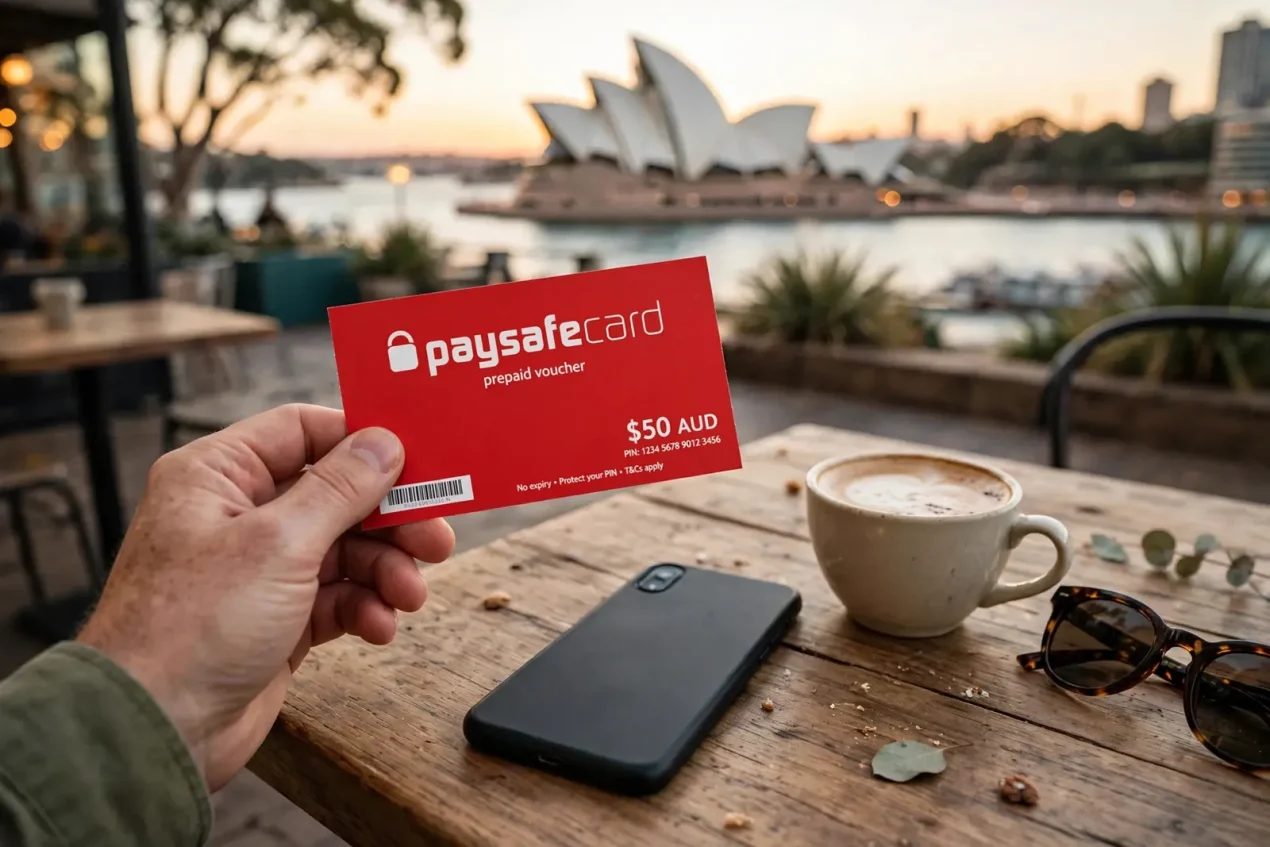
A payment logo can suggest that a method is relevant to a service, but it does not by itself establish that you can use it. A symbol may appear in general payment information without confirming that it applies to a particular account, location or transaction. For Paysafecard, a logo alone would not show that a casino accepts it from people in Australia.
Searching for PayID Casinos in Australia: Legal Context
The important distinction is between a method being familiar in the wider payment market and being supported for a specific purpose by a particular service. Neither one proves the other. Even where a payment method is mentioned, the wording may not make clear whether it relates to deposits, withdrawals or both. Those are separate functions, and a reference to one should not be read as confirmation of the other.
The same caution applies to labels such as “available” or “accepted”. Without clear, current terms tied to the service and transaction in question, such wording leaves practical details unresolved. A logo may be decorative, outdated or intended to describe a general capability rather than an option available to every customer. It is not a substitute for precise information.
This is why claims about Paysafecard should not be treated as proof merely because the brand appears beside a casino name or in a broad payment list. The relevant question is whether the service’s own current information clearly identifies Paysafecard as an available method for the transaction being discussed. If it does not, acceptance should not be assumed.
The same standard applies to claims about a Paysafecard payout or games said to pay directly to it. A reference to a payment brand does not establish a route for winnings, and a game’s payment behaviour cannot be inferred from a method’s general presence. The logo is a prompt to look for a specific, unambiguous statement—not evidence that the method is usable.
Payment Logic
A payment logo is a prompt to seek an unambiguous statement, not evidence that a method is usable.
Everyday payments in Australia are not casino payment guarantees
Contactless credit and debit cards are accepted almost everywhere in Australia. Mobile wallets such as Google Pay and Apple Pay are similarly widespread in everyday transactions. That familiarity can make it tempting to assume a payment method will work wherever an online payment is offered. The assumption does not follow.
A tap at a shop and a payment to an online casino are different transactions, handled by different businesses and payment arrangements. A card or wallet’s broad acceptance at Australian retailers does not establish that a particular casino accepts it. Nor does it show that a casino accepts Paysafecard, whether the cashier displays the brand, or whether a payment would be available to someone in Australia.
This distinction matters when you are trying to establish whether an Australian casino accepts Paysafecard. Familiarity with contactless payments says nothing about that separate question. Even if a payment product is common in shops, its availability in an online gambling cashier cannot be inferred from its general popularity. The same caution applies to Google Pay and Apple Pay: everyday acceptance is not confirmation of casino acceptance.
Treat claims about a Paysafecard option as claims about a specific service, not as an extension of how Australians pay at local retailers. Availability may depend on the individual operator and the transaction being offered. A general statement that Australians can tap a card or use a mobile wallet is not evidence that an online Australian casino uses Paysafecard.
The practical takeaway is narrow but useful: separate ordinary retail payment habits from the options a particular online service says it supports. Australia’s widespread use of contactless cards and mobile wallets provides context about daily payments; it does not verify a Paysafecard casino, or establish that any casino accepts Paysafecard for Australian customers. Don’t treat a familiar payment method—or its popularity in shops—as proof that it can be used in an online gambling transaction.
Paying online: separate general habits from casino availability
Australian consumers are comfortable moving between cards, mobile wallets and bank-linked services such as PayPal when paying online. That habit shows familiarity with several ways to make a digital payment; it does not show that every service accepts every method, or that a particular payment option is available for casino transactions.
Paysafecard support needs to be treated as a separate question. Familiarity with online payments cannot establish whether you can pay by Paysafecard at a casino, whether the method appears in its cashier, or whether a payment would be accepted. General patterns in how Australians pay are not evidence about a specific operator’s arrangements.
The distinction matters because payment methods are not interchangeable. A card, a mobile wallet, a bank-linked service and a prepaid voucher each have their own acceptance conditions. Seeing one of these options in use across ordinary online purchases does not tell you whether Paysafecard works at a particular casino. Nor does a general description of a casino payment method confirm that the method is available to Australian customers.
Casinos That Accept Mastercard in Australia: What to Check
Searches for a Paysafecard casino payment method often combine two different issues: whether people commonly use a service online, and whether a casino accepts it. The first can be described in broad terms; the second requires information specific to the service and the transaction. Without that, claims about which casino accepts Paysafecard cannot be established from Australian consumers’ general payment habits.
The same care applies to references to pokies or other casino games being playable with Paysafecard. A payment method’s familiarity is not proof that it can be used to fund a gambling account, and it says nothing about whether a transaction will go through. Keep the claims separate: Australians may be comfortable using cards, mobile wallets and bank-linked services, while Paysafecard availability at any given casino remains a distinct matter.
How do you check if casino sites accept Amex deposits?
Check the casino’s cashier or payment information for American Express, then confirm that it is available to you before entering card details. A payment option being listed does not make an online casino legally permitted to serve people in Australia.
What are the deposit and withdrawal limits at the best Amex casinos?
Each casino sets its own Amex deposit and withdrawal limits, so check the limits shown by that casino. Amex limits are usually higher than those for Visa or Mastercard.
Are casino Amex payments instant?
Amex deposits are processed instantly. Withdrawals to Amex can take up to five days to clear.
Does American Express work for online casinos?
Yes, some online casinos accept American Express deposits, but not all do, and some may block withdrawals to the card. In Australia, operators are prohibited from providing real-money online casino games to people physically in the country.
Are there fees for using Amex at online casinos?
Amex deposits typically have no fee, but a casino may add a 1.5% surcharge, and Amex cards incur a 3% currency conversion fee. Withdrawal fees may also apply.
Are there any fees associated with using American Express at online casinos?
Amex deposits typically have no fee, but a casino may add a 1.5% surcharge, and Amex cards incur a 3% currency conversion fee. Withdrawal fees may also apply.
This material was created by the Stellar Spins Notes team.
Related posts

Real-Money Casino Table Games in Australia

Pokies Tips and Tricks: What Actually Affects Play