
Stellar Spins Cosmic Missions and loyalty points
 Available in US
Contents
Cosmic Missions is the Stellar Spins loyalty and points system. Its defining mechanic is not a single flat earning rate: video slots, table games and roulette, and blackjack or video poker all accrue points at different levels of turnover. Those points can unlock the Wheel of Wonder and rewards that include free spins, bonuses and cash, so understanding the programme starts with the earning ratios rather than the reward labels.
Cosmic Missions is built around points from game turnover
The programme links loyalty progress to wagering activity. Stellar Spins describes Cosmic Missions as a points system in which game turnover contributes at category-specific rates, meaning the same amount staked does not translate into the same number of points across the casino.
That structure separates the programme from a simple visit-based or deposit-based loyalty scheme. The key unit is game turnover, and the earning rule changes according to what type of game creates that turnover. A person can therefore understand the programme mechanically without making assumptions about the value of any eventual reward.
The broader game catalogue matters because Cosmic Missions uses game type as part of the calculation. Slots, table games, roulette, blackjack and video poker are not interchangeable for points accrual even when they sit inside the same casino account.
For a general product overview, the Stellar Spins review places the loyalty system alongside payments, games, verification and independent trust signals. Here the focus stays on the points mechanics themselves.
Point rates differ sharply across game categories
The programme publishes three distinct earning rates. Video slots earn one point for each $10 in bets. Table games and roulette require $125 in bets for one point. Blackjack and video poker require $500 in bets for one point.
| Game category | Published point rate | Turnover required for one point |
|---|---|---|
| Video slots | 1 point per $10 in bets | $10 |
| Table games and roulette | 1 point per $125 in bets | $125 |
| Blackjack and video poker | 1 point per $500 in bets | $500 |
The comparison shows why a single points balance cannot be interpreted without knowing which games produced it. The turnover required for one point rises substantially from video slots to the other categories, so equal wagering activity can create very different progress through the same loyalty system.
This is a programme mechanic, not a recommendation about which games to play. The higher accrual rate on one category does not make that category safer, cheaper or more likely to return money. Loyalty points sit on top of gambling activity; they do not change the underlying risk of loss.
The numerical gap is large enough to matter in any comparison of point balances. Table games and roulette require 12.5 times as much turnover per point as video slots, while blackjack and video poker require 50 times as much. Those ratios come directly from the $10, $125 and $500 earning intervals and explain why raw point totals can look very different even when total betting activity is closer.
That weighting also means a points balance cannot be reverse-engineered into one exact wagering total without knowing the mix of categories. A balance produced entirely through video slots corresponds to a different amount of turnover from the same balance produced through blackjack or video poker.
Equal turnover does not create equal loyalty progress
The simplest consequence of the rate table is that Cosmic Missions weights game categories differently. A player using video slots reaches each point after much less turnover than a player using blackjack or video poker, while table games and roulette sit between those two ends.
That weighting matters when comparing activity across sessions. Two accounts can show similar total wagering while accumulating loyalty points at very different speeds because the programme applies a different denominator to each game category. The points total therefore reflects both activity and game mix.
- Video slots: the shortest turnover interval between points at $10 per point.
- Table games and roulette: a wider interval at $125 per point.
- Blackjack and video poker: the widest published interval at $500 per point.
The practical reading is not that one route is “better.” It is that the programme intentionally assigns different loyalty weight to different forms of play. Anyone comparing point balances needs that context before treating points as a simple proxy for how much an account has wagered.
This distinction is especially useful when moving between the loyalty system and the casino catalogue. A broad selection of games can create many possible session mixes, but Cosmic Missions converts those mixes into points at non-uniform rates.
In practical terms, loyalty progress is a weighted record of activity rather than a neutral meter of total stakes. The programme gives much more points weight to some categories than others. That is useful for interpreting the system, but it should not be confused with a measure of game quality, expected return or financial outcome.
The weighting can also change the meaning of cross-session comparisons. A session focused on one category may move the loyalty balance faster than a session with the same nominal turnover in another category, even though the underlying gambling spend is still real in both cases.
Rewards sit after the points mechanic
Stellar Spins says Cosmic Missions points can unlock the Wheel of Wonder, with rewards that include free spins, bonuses and cash. The reward layer comes after the earning layer: first the programme counts activity at the published game-category rates, then accumulated points can be used within the mission and reward structure.
That order is important for interpretation. A reward description may be visually prominent, but the cost side of the mechanism is the wagering activity required to generate points. Because those requirements differ by game type, the earning table is more informative than treating “free spins,” “bonuses” or “cash” as standalone benefits.
Rewards also should not be treated as a recovery mechanism for gambling losses. They are part of a loyalty programme attached to wagering activity, and gambling can result in loss of money regardless of whether a points system is present.
The reward categories themselves are broad: free spins, bonuses and cash can represent different mechanics once they are applied. They are listed as programme reward types, but those labels do not translate into one single monetary value. The earning rates are the concrete part of the system that can be compared directly.
That distinction keeps the programme readable without promotional framing. The points system tells you how activity is counted; the reward list tells you the kinds of outcomes the Wheel of Wonder can produce. Neither statement implies that the value received offsets the gambling turnover needed to reach it.
The account provides the common base for loyalty activity
Cosmic Missions operates within the same player account used for casino activity. That means its points mechanics sit alongside the account’s identity requirements, one-account rule and account-control options rather than forming a separate profile.
The verification and account guide covers that underlying layer: identity documents, the stated verification window, one-account rule, deposit limits and account closure controls. The loyalty programme then adds a game-activity calculation on top of the account rather than replacing any of those requirements.
This separation helps keep two different questions distinct. Account rules define who the profile belongs to and which controls apply to it. Cosmic Missions defines how eligible game turnover is translated into points and how those points connect to the programme’s reward layer.
- The player uses one account profile.
- Game activity is grouped by category for loyalty purposes.
- Each category uses its published turnover-per-point rate.
- Accumulated points feed into Cosmic Missions and the Wheel of Wonder reward structure.
That sequence describes the mechanics without assuming that loyalty participation changes the economics of the underlying games.
It also shows why account controls remain relevant even when loyalty is the topic. Points are generated through gambling activity on the same account that carries deposit limits and closure options. Loyalty progress does not sit outside those controls or create a separate identity.
For a reader assessing the product, that separation is useful: account mechanics explain access and controls, game pages explain the catalogue, and Cosmic Missions explains only the conversion from category-specific turnover into loyalty points and rewards.
Questions about Cosmic Missions
What is Stellar Spins Cosmic Missions?
Cosmic Missions is the Stellar Spins loyalty and points programme. Points are earned from game turnover at rates that differ by game category.
How many bets are needed for one Cosmic Missions point on video slots?
The published rate is one point for each $10 in video-slot bets.
How does the point rate work for table games and roulette?
Table games and roulette earn one point for each $125 in bets.
What is the point rate for blackjack and video poker?
Blackjack and video poker earn one point for each $500 in bets.
What can Cosmic Missions points unlock?
Stellar Spins says points can unlock the Wheel of Wonder and rewards including free spins, bonuses and cash.
Cosmic Missions changes pace with the game type
The loyalty system’s central trade-off is the large gap between its category rates. Video slots accrue one point per $10 in bets, table games and roulette use $125, and blackjack or video poker use $500. Those ratios mean a points balance reflects the mix of games behind the activity, not turnover alone. The reward layer comes later; the first thing to understand is how the programme weights each form of play.
This material was created by the Stellar Spins Notes team.
Related posts
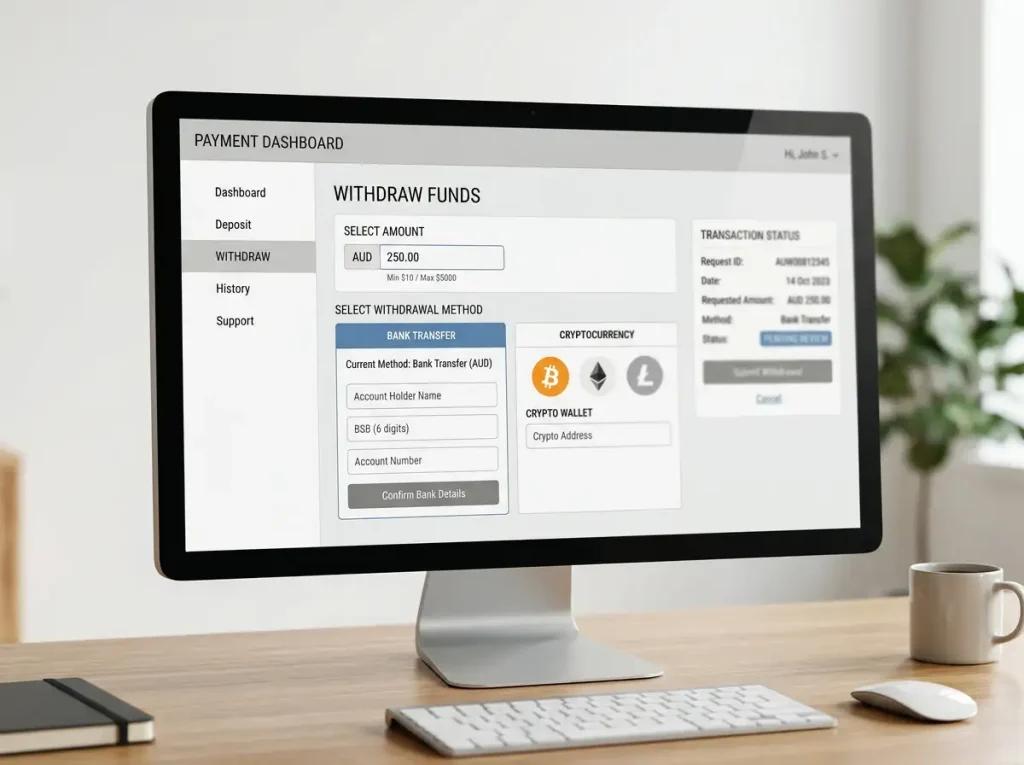
Stellar Spins withdrawal limits and cashout rules

Stellar Spins payment methods and deposit setup